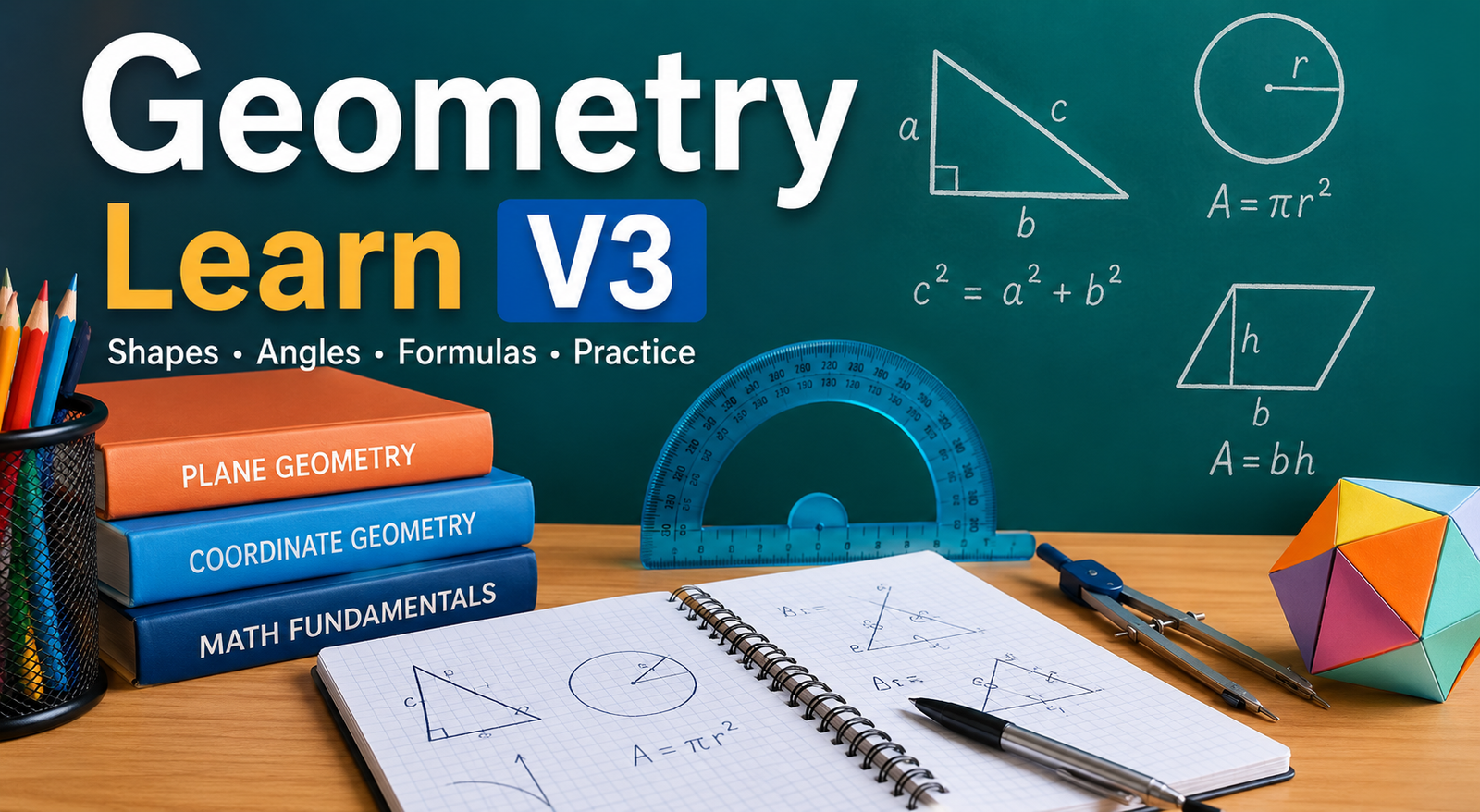
Geometry Learn V3: A Simple Guide to Master Geometry
Master Shapes, Angles, Formulas, and Geometry Skills Easily

Introduction
Geometry Learn V3 can be understood as a modern approach to learning geometry through clear concepts, visual examples, formulas, and practical problem-solving. Geometry is an important branch of mathematics that focuses on shapes, sizes, positions, angles, distances, and relationships between objects.
For many students, geometry can seem difficult because it combines mathematical formulas with visual thinking. A structured learning approach can make these concepts easier to understand. By learning one topic at a time and practicing regularly, students can build confidence and improve their mathematical skills.
What Is Geometry?
Geometry is the study of points, lines, angles, shapes, surfaces, and spatial relationships. It appears in many areas of everyday life, including architecture, engineering, construction, design, art, computer graphics, and science.
Basic geometry begins with simple ideas such as points and lines and gradually moves toward more advanced concepts such as triangles, circles, polygons, coordinate geometry, and geometric proofs.
Important Topics in Geometry Learn V3
A useful geometry learning program should cover several fundamental areas.
Points, Lines, and Angles
Points represent exact locations, while lines describe straight paths between locations. Angles are created when two lines or rays meet.
Students commonly learn about acute, right, obtuse, straight, and reflex angles. Understanding angle types is essential because many geometry problems require identifying relationships between different angles.
Triangles
Triangles are among the most important shapes in geometry. They have three sides and three interior angles.
Triangles can be classified according to their sides as equilateral, isosceles, or scalene. They can also be classified according to their angles as acute, right, or obtuse.
The interior angles of every triangle add up to 180 degrees. This simple rule is used in many geometry calculations.
Quadrilaterals and Polygons
Quadrilaterals have four sides and include squares, rectangles, parallelograms, rhombuses, and trapezoids.
More generally, polygons are closed shapes made from straight line segments. Learning their properties helps students calculate angles, perimeter, and area.
Circles
Circles are another major part of geometry. Important terms include radius, diameter, circumference, chord, tangent, and arc.
The radius is the distance from the center of a circle to its edge, while the diameter passes through the center and is twice the radius.
Students also learn how to calculate the area and circumference of circles.
Perimeter and Area
Perimeter measures the distance around a two-dimensional shape. Area measures the amount of space inside it.
For example, the perimeter of a rectangle can be found by adding all four sides. Its area is calculated by multiplying its length by its width.
Understanding the difference between perimeter and area is essential for solving practical problems involving rooms, gardens, fields, floor plans, and other spaces.
The Pythagorean Theorem
The Pythagorean theorem is one of the best-known concepts in geometry. It applies to right-angled triangles and connects the lengths of the two shorter sides with the hypotenuse.
This theorem has applications in construction, surveying, navigation, architecture, and many other fields.
Coordinate Geometry
Coordinate geometry combines algebra with geometry. Shapes and points can be represented on a coordinate plane using horizontal and vertical axes.
Students may learn how to identify coordinates, calculate distances, find midpoints, determine slopes, and analyze lines.
This topic is particularly useful because it demonstrates how algebraic equations can describe geometric objects.
Why Visual Learning Matters
Geometry is highly visual. Instead of memorizing formulas alone, learners can benefit from diagrams, interactive figures, and step-by-step examples.
A visual approach can help students understand why a formula works rather than simply memorizing it. For example, moving the vertices of a triangle can demonstrate how side lengths and angles change while certain geometric relationships remain true.
How to Learn Geometry Effectively
A successful geometry study routine should combine understanding and practice.
Start with the basics: Learn points, lines, angles, and simple shapes before moving to advanced topics.
Draw diagrams: Creating a diagram can make complicated geometry questions much easier to understand.
Learn formulas with meaning: Understand what each measurement represents instead of memorizing formulas without context.
Practice regularly: Solving several problems every day can improve accuracy and speed.
Check your work: Review calculations and compare the result with the diagram to see whether the answer makes sense.
Common Geometry Mistakes
Students often make a few predictable mistakes when studying geometry. One common problem is confusing area with perimeter. Another is using the wrong formula for a particular shape.
Incorrectly identifying an angle or forgetting units can also lead to wrong answers. Drawing a clear diagram and writing down the known information before calculating can reduce these errors.
Geometry in Everyday Life
Geometry is not limited to classrooms. Buildings depend on geometric measurements, roads use angles and distances, designers work with shapes and proportions, and digital graphics rely heavily on geometric calculations.
Even activities such as arranging furniture, measuring a wall, planning a garden, or creating a pattern can involve geometry.
Benefits of Geometry Learn V3
A structured learning approach such as Geometry Learn V3 can help learners organize their studies around fundamental concepts and gradually progress toward more challenging problems.
Its greatest value comes from combining explanations, visual learning, formulas, and practical exercises. This approach can support students who need a stronger foundation as well as learners who want additional geometry practice.
Conclusion
Geometry Learn V3 represents a practical way to approach geometry through organized concepts, visual understanding, and consistent practice. From basic angles and triangles to circles, polygons, area, perimeter, and coordinate geometry, each topic builds a foundation for the next.
The key to mastering geometry is not simply memorizing formulas. Students should understand the relationships behind those formulas, draw useful diagrams, practice different types of questions, and review mistakes. With regular learning and problem-solving, geometry can become a much more understandable and enjoyable part of mathem