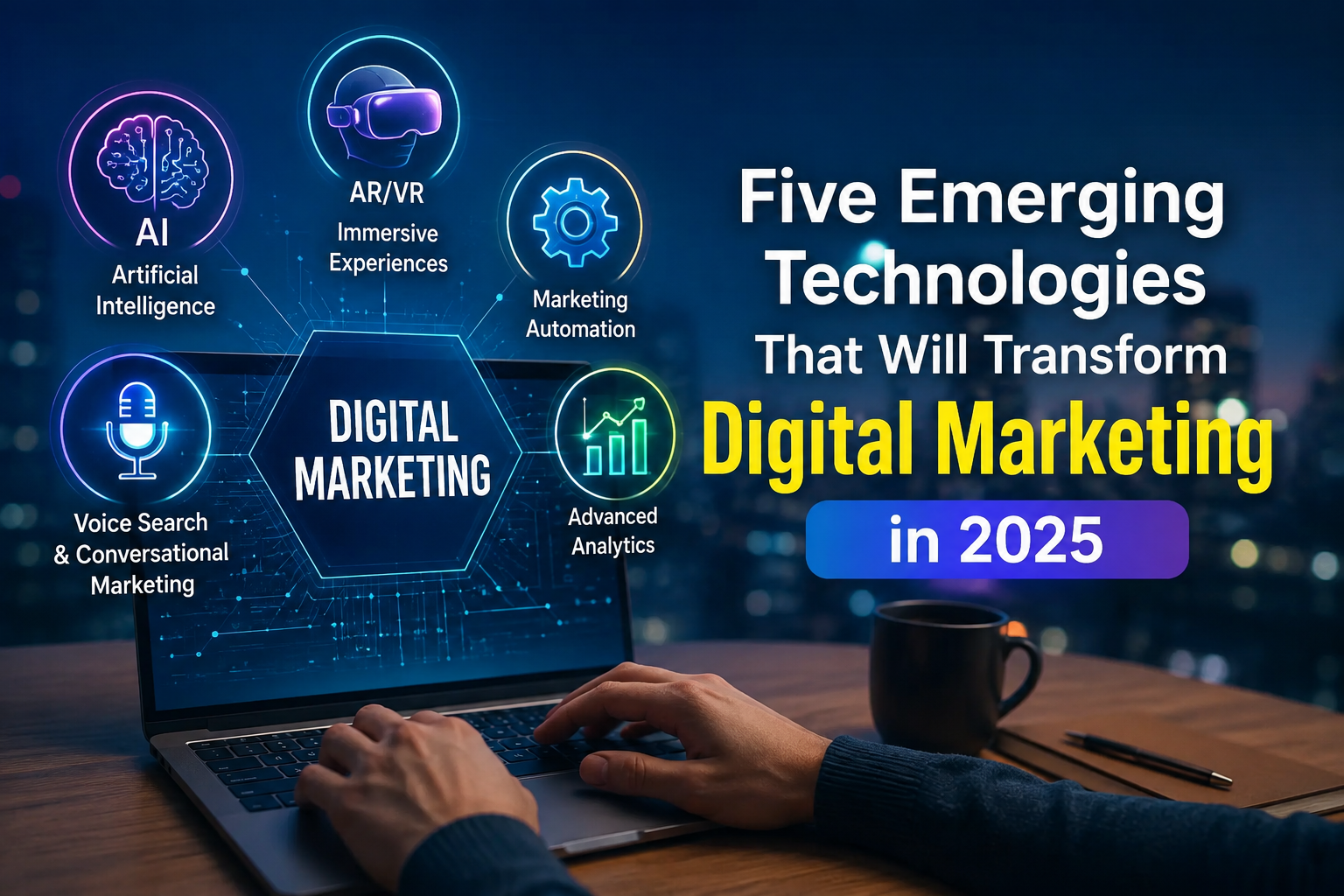
Five Emerging Technologies That Will Transform Digital Marketing in 2025
Smarter Tools, Better Personalization, and More Powerful Customer Experiences

Introduction
Digital marketing continues to evolve as new technologies change how brands communicate with customers. In 2025, businesses are expected to rely more heavily on artificial intelligence, automation, immersive experiences, advanced data tools, and intelligent search technologies. These innovations can help marketers understand audiences, create better content, improve customer experiences, and make faster decisions.
Table of Contents
ToggleThe digital landscape is becoming increasingly competitive. Simply publishing content or running advertisements is no longer enough. Successful brands need to understand changing consumer behavior and use technology strategically. Here are five emerging technologies that are transforming digital marketing and influencing the future of online business.
Artificial Intelligence and Generative AI
Artificial intelligence is one of the most influential technologies in modern digital marketing. Generative AI can assist marketers with content creation, campaign ideas, customer communication, data analysis, and personalization.
Businesses can use AI-powered tools to create drafts for blog posts, social media content, email campaigns, product descriptions, and advertisements. AI can also analyze large amounts of customer information and identify patterns that may be difficult to discover manually.
Another important application is predictive marketing. AI systems can analyze previous customer behavior to estimate what consumers may want next. Marketers can then use these insights to deliver more relevant offers and recommendations.
However, AI works best when combined with human creativity and judgment. Brands still need authentic voices, accurate information, strong storytelling, and meaningful connections with their audiences.
Augmented Reality and Virtual Reality
Augmented reality (AR) and virtual reality (VR) are creating new possibilities for interactive marketing. Instead of simply seeing an advertisement, consumers can experience products and services in more engaging ways.
For example, AR can allow customers to visualize furniture inside their homes, try virtual clothing or accessories, or preview products before making a purchase. This can reduce uncertainty and make online shopping more interactive.
Virtual reality can take immersive marketing even further. Travel companies, real estate businesses, entertainment brands, and educational organizations can use VR experiences to give customers virtual tours and demonstrations.
As immersive technologies become more accessible, marketers may increasingly use AR and VR to create memorable brand experiences rather than relying solely on traditional advertisements.
Advanced Marketing Automation
Marketing automation is becoming more intelligent as businesses adopt AI-powered platforms and sophisticated customer-management systems. Automation allows marketers to deliver the right message to customers based on their behavior, interests, and stage in the buying journey.
For example, an automated system can send a welcome email after someone subscribes to a newsletter. It can later provide educational content, recommend relevant products, or remind a customer about an unfinished purchase.
Modern automation can also help businesses segment audiences more effectively. Instead of sending identical messages to everyone, marketers can create different experiences for new visitors, returning customers, loyal buyers, and inactive users.
The major benefit is efficiency. Automation reduces repetitive work while allowing marketing teams to concentrate on strategy, creativity, and customer relationships.
Voice Search and Conversational Marketing
Voice technology is changing the way people interact with digital platforms. Consumers increasingly use smartphones, smart speakers, and voice-enabled devices to search for information, ask questions, and find products or services.
This creates new opportunities for digital marketers. Businesses need to consider conversational search phrases and natural-language queries when developing their content strategies.
Conversational marketing is also becoming more important. AI-powered chatbots and virtual assistants can answer customer questions, provide product information, assist with basic support, and guide visitors through websites.
A well-designed conversational experience can make a brand more accessible and responsive. Instead of forcing customers to search through multiple pages, businesses can provide quick answers through interactive communication.
Advanced Data Analytics and Predictive Technology
Data remains one of the most valuable resources in digital marketing. In 2025, advanced analytics and predictive technologies are helping businesses turn large amounts of information into actionable insights.
Traditional analytics can show what happened in a campaign. Predictive analytics goes further by helping marketers estimate what could happen next. Businesses can use customer behavior, purchasing patterns, website activity, and campaign performance to identify potential trends.
For example, predictive systems may help determine which customers are more likely to purchase a particular product or which marketing channels are producing stronger results.
At the same time, marketers must pay close attention to privacy and responsible data usage. Customers increasingly expect businesses to handle personal information transparently and securely.
How These Technologies Work Together
The biggest change may not come from one technology alone. The real transformation happens when businesses combine several technologies into a connected marketing strategy.
For example, AI can analyze customer data, automation can deliver personalized messages, conversational tools can answer questions, and AR can provide an interactive product experience. Together, these technologies can create a smoother customer journey.
Businesses that successfully connect these tools can potentially improve efficiency while delivering more personalized experiences.
Benefits for Digital Marketers
The adoption of emerging technologies can provide several advantages:
- Better personalization: Businesses can create experiences based on individual customer interests.
- Faster content production: AI can assist teams with research, ideas, and content drafts.
- Improved customer service: Chatbots and conversational systems can provide quick assistance.
- More engaging experiences: AR and VR can make product discovery more interactive.
- Smarter decisions: Advanced analytics can help marketers identify patterns and opportunities.
- Greater efficiency: Automation can reduce repetitive marketing tasks.
Challenges Businesses Should Consider
Technology alone does not guarantee marketing success. Businesses must also consider implementation costs, employee training, data privacy, cybersecurity, and the quality of customer experiences.
AI-generated content should be reviewed for accuracy and originality. Automated campaigns should be monitored to prevent irrelevant communication. Data-driven marketing should respect applicable privacy requirements and customer expectations.
Another challenge is choosing the right technology. Businesses do not need to adopt every new tool. Instead, they should identify technologies that solve real customer problems and support measurable business goals.
The Future of Digital Marketing
The future of digital marketing will be increasingly intelligent, personalized, automated, and interactive. AI will continue supporting marketers, while immersive technologies can create new ways to experience products. Automation will improve customer journeys, voice and conversational technologies will influence search and communication, and advanced analytics will support better decision-making.
The most successful marketers will not simply chase every new trend. They will understand how technology can support genuine customer needs. Creativity, strategy, trust, and human connection will remain essential even as digital tools become more advanced.
Conclusion
The five emerging technologies shaping digital marketing in 2025—artificial intelligence, AR and VR, advanced automation, voice and conversational technology, and predictive analytics—are changing how brands reach and understand consumers.
Businesses that adopt these technologies thoughtfully can improve personalization, efficiency, engagement, and decision-making. However, technology should always serve a clear marketing purpose. The strongest digital strategies will combine innovative tools with valuable content, authentic communication, responsible data practices, and a strong understanding of customers.