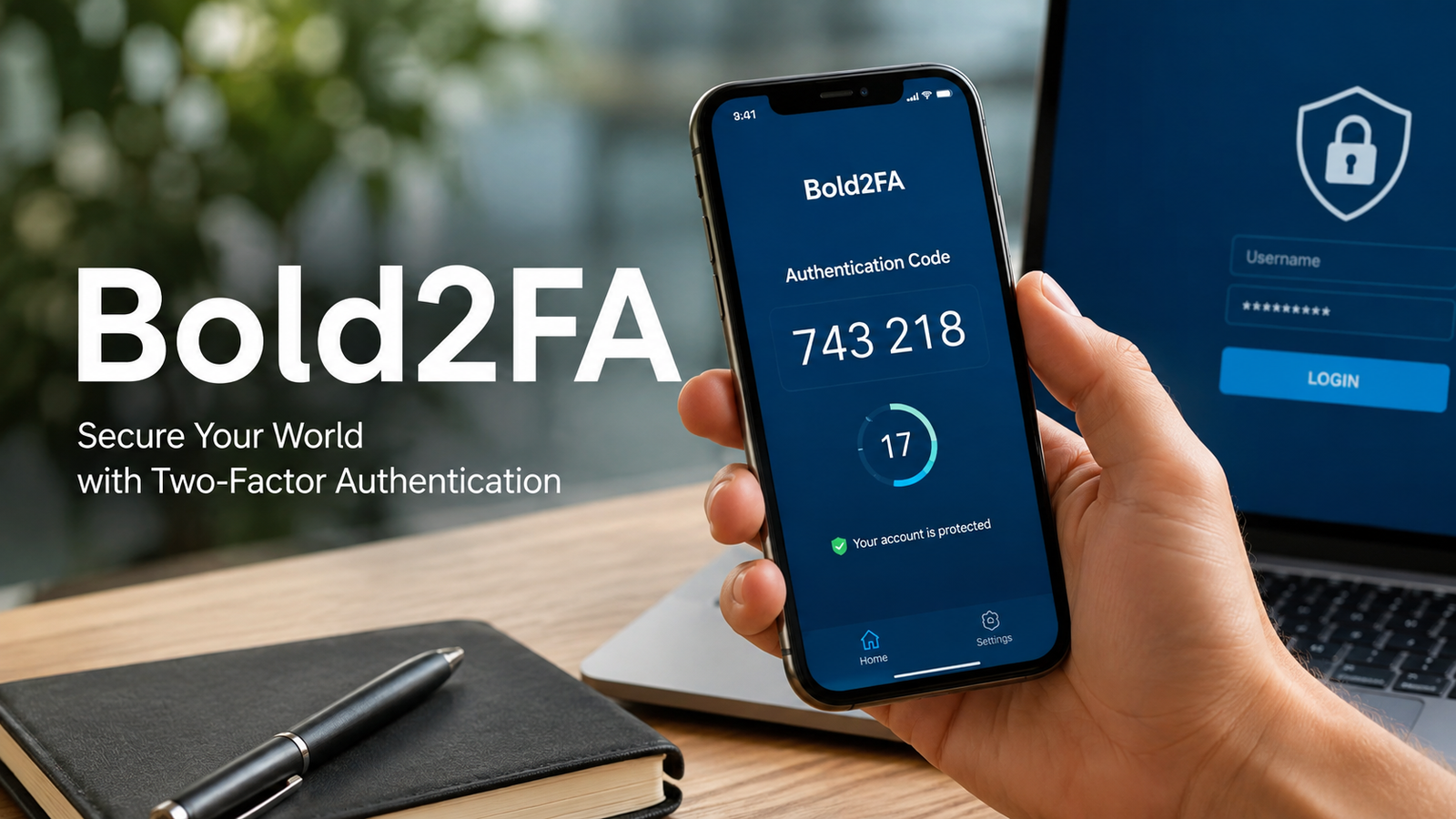
Bold2FA: A Practical Guide to Modern Two-Factor Authentication
Understanding Bold2FA, its security benefits, features, and everyday uses

Online accounts face constant security threats, from stolen passwords to phishing attempts and unauthorized login attempts. As a result, businesses and individuals increasingly use two-factor authentication (2FA) to add another layer of protection. Bold2FA is a keyword associated with two-factor authentication and secure account access.
Table of Contents
ToggleThis guide explains what Bold2FA means in the context of digital security, how 2FA works, why it matters, and what users should consider when choosing an authentication solution.
What Is Bold2FA?
Bold2FA can be understood as a two-factor authentication-focused security term or service name. Two-factor authentication requires users to provide two different forms of verification before accessing an account.
Instead of relying only on a password, a typical 2FA process combines:
- Something you know, such as a password or PIN
- Something you have, such as a smartphone or security key
- Something you are, such as a fingerprint or facial recognition
The purpose is straightforward: if someone obtains your password, they still need the second authentication factor to gain access.
How Two-Factor Authentication Works
A standard 2FA login normally follows a simple process.
Enter Your Username
The user begins by entering their username, email address, or account ID.
Enter the Password
The next step requires the account password. This provides the first authentication factor.
Complete the Second Verification
The system then requests an additional verification method. Depending on the service, this could be:
- A code from an authenticator application
- A security key
- A biometric check
- A push notification
- A one-time password
Account Access
After the second factor is successfully verified, the user can access the account.
This additional step can make unauthorized access considerably more difficult.
Why Bold2FA and 2FA Matter
Passwords remain one of the most common targets for cybercriminals. People may reuse passwords across different websites, choose predictable passwords, or accidentally reveal credentials through phishing attacks.
Two-factor authentication helps reduce the consequences of a compromised password.
Even if an attacker obtains a password, they may be unable to complete the second verification step.
For businesses, stronger authentication can also help protect customer information, employee accounts, financial systems, and internal applications.
Key Benefits of Two-Factor Authentication
Better Account Protection
The biggest advantage is an additional security barrier beyond the password.
Protection Against Stolen Passwords
A compromised password alone may not be enough to access a properly protected account.
Reduced Risk of Unauthorized Access
2FA can make automated credential attacks and password-based intrusions more difficult.
Greater Security for Sensitive Accounts
Email, banking, cloud storage, social media, and business accounts can all benefit from additional authentication.
Improved Security Awareness
Using 2FA encourages users to think about account security beyond simply creating a password.
Common Types of 2FA
Not every authentication method provides the same level of security. Common options include the following.
Authentication Apps
Apps generate temporary verification codes. These codes typically change regularly and are used during login.
SMS Codes
A service can send a one-time code to a registered phone number. Although convenient, SMS-based authentication has security limitations and is generally less robust than phishing-resistant methods.
Security Keys
Hardware security keys provide a physical authentication factor. They can offer strong protection against phishing when supported by modern authentication standards.
Push Notifications
A user receives a notification on a trusted device and approves or rejects the login attempt.
Biometrics
Fingerprint or facial recognition can provide another way to verify a user’s identity, usually through a trusted device.
Bold2FA for Businesses
Businesses increasingly need strong authentication because employees access systems from offices, homes, mobile devices, and public networks.
A 2FA solution can support security policies by requiring additional verification for important accounts.
For example, an organization might require 2FA for:
- Email accounts
- Administrative dashboards
- Cloud platforms
- Financial systems
- Customer databases
- Remote-access services
- Developer platforms
Companies should also create backup procedures so authorized employees can recover accounts if a phone or authentication device is lost.
Bold2FA and User Convenience
Security should not become unnecessarily difficult. A good authentication experience should balance protection with usability.
Users generally prefer authentication methods that are:
- Fast
- Reliable
- Easy to understand
- Compatible with their devices
- Supported by account recovery options
Organizations should provide clear instructions and training so users understand why additional verification is required.
Is Two-Factor Authentication Completely Secure?
No security method provides absolute protection.
Two-factor authentication can significantly improve account security, but attackers may still use techniques such as phishing, social engineering, malware, or session theft.
For stronger protection, users should combine 2FA with other security practices:
- Use unique passwords.
- Consider using a password manager.
- Keep devices and applications updated.
- Avoid suspicious login links.
- Review account activity regularly.
- Use phishing-resistant authentication when available.
- Keep secure recovery methods available.
Best Practices for Using Bold2FA
If Bold2FA refers to a specific authentication service or implementation, users should verify its official documentation and security features before relying on it.
Regardless of the particular 2FA platform, these practices are useful:
Keep Recovery Codes Secure
Backup codes should be stored somewhere safe. They should not be posted publicly or shared with other people.
Protect Your Primary Device
If your phone or computer is used for authentication, protect it with a strong screen lock and current security updates.
Never Share Authentication Codes
Legitimate support personnel generally should not ask users to disclose one-time authentication codes.
Check Login Notifications
Unexpected authentication requests can indicate that someone is attempting to access an account.
Prefer Stronger Authentication
Where supported, security keys and phishing-resistant authentication methods can provide stronger protection than traditional SMS codes.
The Future of Authentication
Digital authentication continues to evolve. Passwordless technologies, passkeys, biometrics, and hardware-backed security are becoming increasingly important.
Modern authentication approaches aim to make accounts both safer and easier to use. Instead of remembering complicated passwords and repeatedly entering codes, users may increasingly authenticate through trusted devices and cryptographic credentials.
This shift could reduce some of the risks associated with traditional passwords.
Conclusion
Bold2FA is a useful keyword to explore in the broader context of two-factor authentication and digital account protection. 2FA adds an important security layer by requiring more than just a password during login.
Whether used by individuals or businesses, effective authentication should be combined with unique passwords, secure devices, software updates, careful phishing awareness, and reliable account recovery procedures.
As online threats continue to evolve, stronger authentication remains one of the most practical ways to improve digital security.